The Lies we believe…  A trail tip

Just finished watching the two season TV drama series “Pachinko” on Apple TV.  It’s a story of a multi-generation Korean family that moves to Japan and covers the time period from the early 1900’s to the 1980’s.  A few of the episodes take place during World War II, where it shows the family preparing for the Allied invasion by making bamboo poles into spears.  They are told they must get ready for the invasion because the Allies will capture them and tear out their hearts.  The Americans are seen as evil and barbaric.  Lies told to the Koreans time and time again.  At first, the lies don’t seem believable, but as they are told over and over again, they become more believable, are cemented in their hearts, and are taken for granted as Truth.

In hiking most of the lies I believe are focused on hikes I don’t think I can do, so I begin to tell myself I don’t care about doing Class 3 14er’s or any 14er’s for that matter.  And then there are the local hikes like Cameron’s cone, a 7mile out and back with 4200 feet; meaning you climb 4200 feet in 3.5 miles. All hikes that I know I can train to do, but I make up stories to tell others why I can’t/don’t want to do them.  So not only am I believing the lies I’m telling myself; but I’m also telling others my lies and getting them to believe the lies about me. Talk about a process that feeds on it’s self and makes the lies worse day by day.

In my personal life, there are lots of areas where I tell myself lies.  Areas such as family relationships where we don’t speak to each other for months and years because of simple misunderstanding that can began to be healed when there is a willingness to start talking to each other.  And then there is the social media where we start doing the comparisons of other people’s lives versus my own and I tell myself the lies that I don’t measure up to others.

In my professional life, I tell myself that I don’t need this certification or “that” certification.  And I’ll get along fine without it, yet I know it can make a difference in my professional growth and open new “doors” for me.  A specific example is the Project Management Professional certification.  For the past 7 years I’ve told myself: I can’t afford it (versus there are scholarships to be found), I don’t have time (versus what else have I been doing during the past 7 months of unemployment), I don’t need it (versus half the jobs openings I’ve seen have PMP certification as a requirements), or it is too hard to get (versus there are excellent local trainers who have very high success rates.

There are two quotes that come to mind when I think about lies I believe about myself; both from Timothy Ferriss in his book The 4-Hour Workweek.  1) “Ninety-nine percent of people in the world are convinced they are incapable of achieving great things, so they aim for the mediocre.” 2) “I believe that success can be measured in the number of uncomfortable conversations you’re willing to have.”  Uncovering lies in our lives is hard work and not something you should do by yourself.  Who are the people in your life that can help you uncover and bring to light the lies you are believing? And when are you going to meet with them to start having these uncomfortable conversations about the lies you are believing?

This and other “Trail Tips” can be found at https://www.linkedin.com/in/alfredandersen and www.alandersen.co

Also, a collection of my first 101 tips have been published in a book and is available at Amazon or you can contact me to get an autographed copy of the book.

Playing to your strengths…  A trail tip

I just finished reading the John Grisham novel “Camino Ghosts”, which I think is one of his best works completed.  While the book is great and captivating, I was also struck by the number of books he has written, a total of 50.  As I looked over the list of books written, I began to ponder the thought that all his books are all focused on lawyer type, fiction pieces of work [No non-fiction, Syfy, or other genres].  He is successful because he plays to his strengths.  In comparison, for example, someone like Michael Jorden, who retired from basketball after leading the Chicago Bulls to three world champions and then took up baseball; signing a contract to play with a Double A team.  Conventional Wisdom would make you think he would excel in baseball like he did in basketball.  However, this did not happen and he returned to the Chicago Bulls and helped lead them to another three world champions.  I think Michael Jorden realized that just because he was great in basketball; these athletics strengths did not cross over to baseball.  Which got me thinking about my life and am I “playing to my strengths” or am I looking at social media sites to think I need to be like other people and chase dreams that have nothing to do with my strengths.

In hiking, it’s easy to get caught up in chasing dreams of; 14’ers, climbing the top 100 peaks in Colorado, or setting records on the Manitou incline.  Instead, I need cast off these goals -because they are not mine- and focus on what are my hiking strengths; which center around taking groups of people on hikes on the Colorado Springs front range from Cheyenne Mountain to the Sandstone Ranch open space, where I have completed over 50 unique hikes in this area over the past 3+ years.

In my personal life, FOMO (Fear Of Missing Out) can cause me to almost worship the experiences/exploits of others and think I need to be imitating them.  And when I do, I mostly end up with a poor experience/feeling after I’m done.  Compare this to the experience/feeling that I get when I lead a group of people to the top of one of the local mountains and I see the Shock and Awe on their faces.

At work, we can get into the rut of thinking I need to have “this training” or something else to be successful.  Take a look at what you are doing each day at work. If you have that “sparkle in your eye or spring in your step”, you know you are doing something that plays to your strengths.

The first step is to determine or confirm you are playing to your strengths across the areas of your life; it can be as easy as asking others what they think are your strengths or listening to what others say about you to their friends.  The next step then becomes one of doing some self-evaluating of how you feel after you get done with a task.  Did you feel excitement and satisfaction of the work completed or was it one of drudgery?  As I was driving a group of guys to a trail head to start a recent hike, I overheard one of the guys in the back seat say “I don’t know where we are, how we got here, what we can expect for the hike; but I do know I’m hiking with Al Andersen and it’s going to be a great time.”  That is playing to your strengths…

This and other “Trail Tips” can be found at https://www.linkedin.com/in/alfredandersen and www.alandersen.co

Also, a collection of my first 101 tips have been published in a book and is available at Amazon or you can contact me to get an autographed copy of the book.

Summer Surprises…  A trail tip

As we approach the end of summer, I find myself looking back over the past three months at what I: accomplished, missed out on, and what “SURPRISED” me.  These “Surprises” I defined as things I wasn’t looking for and were not anywhere on my radar as I started the summer.  Yet they became a core bed rock in my summer activities and something I looked forward to each week that will carry over into our summer plans for 2025.  You see; over the past year my wife (Arlene) and I have been doing water exercises at a local YMCA,  In the course of starting to do them this summer; someone mentioned we should look at the two outdoor pools in Colorado Springs.  One is the Wilson Ranch Pool, a more contemporary style pool with splash zones, a lazy river, etc.  The other one is the Monument Valley pool built in 1914 and is on the National Register of Historic Places.  Very old school.  We checked out both places and decided on making the Monument Valley pool our “home” for the summer as it had a deeper swim lane.  Starting to go there in early July, the pool grew on us with a friendly/interactive staff and “home town” feel.  The life guards always got a kick when we requested the songs; “She thinks my Tractor’s sexy” and “Honey Bee”; as which time we would start dancing to them in the pool.  The Summer Surprise didn’t end there, Arlene told me about a Tasty Freeze on the way “home” to get chocolate ice cream cones.  Summer “Surprises” aren’t something you look for; they are things that find you.

In hiking, I’ve been “Surprised” when I realized that I do have a favorite hike in the front range, which is the “Craigs” on the west side of Pikes Peak.  As I hiked it this summer with grandkids (ages: 1, 4, and 7) and daughter Ashley, I realized it has all the check boxes: forest, open meadows, some easy scrambling, a creek, great views, only five miles, and 800 feet vertical.  A great hike for visitors and “seasoned” hikers.

In my personal life, I’ve recently been “Surprised” about how “easy” it is to start having morning devotions with Arlene.  Something I’ve been struggling with for the past 40 years; we are now doing them about 5 days a week.  The key has been to set a time to do them each day.  The exact morning time may vary, but it becomes “easy” to do when we set a time, i.e.: be it 7:45, 8:20 or 9:30.  And having a devotional with questions becomes our “Trail Guide.”

In work, as I’ve gone through job changes, I’ve been “Surprised” by the incredible friendships formed out of the adversity of going from one job to the next.  These are friendships that continue to grow over the years.

What are the “Surprises” that have come your way this year?  Some of them may be immediately apparent.  Other may take time to incubate and grow; then suddenly they “pop” and appear out of nowhere.  It’s important to let the “Surprises” grow in your life and then share them with others.  You may be the “Surprise” to someone who didn’t know they needed you in their life.

This and other “Trail Tips” can be found at https://www.linkedin.com/in/alfredandersen and www.alandersen.co

Also, a collection of my first 101 tips have been published in a book and is available at Amazon or you can contact me to get an autographed copy of the book.

Life Planning…  A trail tip

What tools do you use to do “Life Planning?”

My professional career is working as a Servant Leader to guide software development teams.  And in this work, we use development tools that allow us to easily make changes in near real time.  While these tools have been widely accepted and put to use in the software world, they haven’t been explained or gotten much traction in our personal lives.  This trail tip is to help explain some of these words and how they can improve the planning of our personal lives.  Words such as:

Program Increment is the set time used to define the amount of work that will be completed in a set of four sprints.

Sprint” is a set time period used to get software development completed, typically two weeks.

“Innovation Planning” is a sprint that follows the completed four sprints and is used to do future planning, take classes, and implement process improvements.

 A problem with this process is that the Innovation Planning sprint can just become another sprint which is focused on getting previous work completed.  This leads to constant focus on development with no opportunity to step back and hit the planning button to refocus on future work to be done.

In our personal lives, you can think of the Innovation Planning sprint as a vacation time or extended long holiday weekend taken over the course of a year.  And the question for me became, “What was I going to do on our upcoming vacation time (Innovation Planning)?  A vacation that would take us to Nashville and beaches in Gulf shore, Alabama.

I started planning for this upcoming vacation and boy-oh-boy was I going to get all caught up.  I had bible reading to catch up on, other books to read, hikes to do every day, and projects to get done at my daughter/son-in-law’s home while visiting them in the Nashville area.  As we began the 1,200-mile drive to their home, I started looking at what was ahead of me and I didn’t like what I saw waiting for me. And thankfully, changes were started to come into focus for me as I was driving.  My focus went from planning painting to planning games and walks to do with three grandkids (ages, 9 months, 4, and 6) and letting my daughter do the painting. The plans for the long hikes and places to explore on the Gulf shore changed to let’s decide on one book to read and daily naps on beach. 

Driving home from the Gulf shore (about 1,500 miles), I had time to process the changes that made this vacation more successful and the word “BUSY” jumped out at me, as I wanted to show how I get things done and how important I am because I have to be busy all the time.  “I’d like to go out to dinner tonight but I’ve got this house project in full swing. Yes, let’s get together and play cards, but I’m swamped for the next two month, so let’s touch base and set a date in three months.  I’d like to be able to help you with that house project on Saturday but I’ve got my own issues to deal with.”  I wear my BUSY badge with pride and honor because I want to show you how important I am with all the busyness I’m doing.  And all this gets me pointing back Program Increments/Innovation Planning and how do I make that part of my life?

For me, it starts with Arlene and me planning the four sprints that will happen over the next two months. What do we want to get done, how long will it take, and how much is it going to cost? Then we have ongoing discussions around; are we are target for cost and timing? Moving to the Innovation Planning sprint; a renewed focus needs to take place with what are we going to do during our Innovation Planning sprint? With the first and most important question being; Have we planned the time for the Innovation Planning sprint and where will it take place? Are we doing a three-day weekend in the mountains, a day trip to a local hot springs, or a weekend at home with cell phones and TV off? Once this is determined, we can start planning the books to read, games to play, topics to discuss and nap (REST) time.

What are your plans to implement a Program Increment process with an Innovation Planning cycle into your life?  I’d like to hear your thoughts by emailing your reactions to alfred.a.andersen@gmail.com

This and other “Trail Tips” can be found at https://www.linkedin.com/in/alfredandersen and www.alandersen.co

Also, a collection of my first 101 tips have been published in a book and is available at Amazon or you can contact me to get an autographed copy of the book.

Misuse of Power…  A trail tip

While reviewing some SAFe (Scaled Agile Framework) material for work, I came across this quote from Pater Block “It is misuse of our power to take responsibility for solving problems that belong to others.”    At first, I thought, hey that’s a nice quote and maybe I should post it on my social media sites.  Then as I kept thinking about it, I realized that there’s a lot to unpack here and it deserves to be a Trail Tip, as there are a lot of examples that can be pulled from this quote.

When leading a hike or just being a trail as part of a group, I try to always pack the: “ten essentials”, extra water, and plenty of food in case someone doesn’t pack what they need. However, the problems can start when someone starts to get used to me “solving problems that belong to others them)”, by always bringing extra water or food for them -just remember extra snickers doesn’t count here.  Getting ready for hikes, I need to be more challenging to others by reminding them to start carrying everything they need for hikes and make it into a Trail Tip teaching moment.

In my personal life, there are examples that can be explored with family and friends.  Here I think of the story of the “Prodigal Son” from the Bible.  The father let the son go when he wanted to leave and while the father heard about the demise of the son; ending up working for a farmer, cleaning pig pens, the father never chased after him to solve his problems, but instead, stayed at home, keeping an eye open for his return.  However, my tendency is to chase after family members and try to solve their problems or do their chores.  I need to remember that while painful to watch, it does not solve problems for them by throwing money at them or doing their areas of responsibilities while living at home.  We so often want the quick fix instead of the longer painful journey.  My neighbor was helping me replace the brakes on our van few years ago, which also involved repacking the wheel bearings.  Oh, how I wanted him to do this part for me.  But no, he just stood there saying nothing as I worked in the new grease that pushed the old gritty grease out.  More than once, I would look at him, looking for a sign I was finished, but he shook his head sideways, signaling there was more to do.  It took more patience and time, than I wanted to spend on it, but once done, the feeling of personal accomplishment was huge.

At work, it’s that same balance of me taking the time to go through the process to learn something new to fix my problem, versus going to someone who knows the answer to get the quick solution.  On the flip side, when someone comes to me with a problem that I know the answer to, my tendency is to say, “give me your keyboard and mouse, so I can fix the problem right away for you.”  Where is the learning for the person who had the initial problem?  Another good work example for me is when we are starting a project and we need to estimate the effort to get the work done.  Development estimates should be done by the developers who are doing the work.  So as the team leader, I need to be quiet and let them work through the estimates, versus me offering advice that isn’t even relevant.

We are living more and more in a world where we want the quick fix.  Why take the time to figure something out and learn something new, when we can go to an “expert”, who is willing to give us that answer we need.  And as someone who has the power and expertise in a given area, we need to guard against readily solving problems for others.  Yes, we can help coach them, but it is not our responsibility to solve their problems for them.

This and other “Trail Tips” can be found at https://www.linkedin.com/in/alfredandersen and www.alandersen.co

Also, a collection of my first 101 tips have been published in a book and is available at Amazon or you can contact me to get an autographed copy of the book.

Do you hear it…  A trail tip

In the 1940 movie “Young Thomas Edison”, there is a scene with a crowded room full of young men all waiting to be interviewed for a Morse Code telegraph operator position.  In the midst of all the chatter and noise going on, Thomas Edison is the only one to hear the Morse Code being tapped out telling them to come into the interview room.  Jumping forward to today; at 5 pm on the Air Force Academy grounds, the “Retreat” is played to signify the end of the duty day and pay respect.  This is then followed by the playing of the National Anthem.  The location of this is about 10 miles from our home.  And on a still, quiet day, I can hear it, as if I was stand right there next to the cadets.  But I can only hear it when I’m being quiet in my heart, listening for it.  In both these examples, the message is: Do you hear it? Is your heart and mind quiet enough to hear the voices in your soul that are trying to speak to you in the mist of all the noise we are bombarded with each day?

When I am out hiking do I hear the quietness of nature around me?  Am I still enough to hear God speaking to my heart or am I letting the chatter of my day, consume my hike.  I have never been a fan of wearing a headset (playing music) while out on a hike.  It can cause me miss the sound of nature, a possible cry for help from someone out on the trail, or being stalked by a Mountain Lion.

In my personal life, what are the voices I’m missing as I go through my busy day.  We are good at asking people how they are doing, but do we really care?  When someone tells me they are doing FINE, I need to follow up with “So what part of Freaked out, Insecure, Noritic, and Emotional are you right now? And let’s take a few minutes to talk about it.”  For ourselves, we can get into trouble when start to internalize problems and do “loops around the mountain”, as we get worked up with the issues we are facing, not able to hear a quiet voice that is trying to speak to us.

In work, we tend to gauge our success by how busy and how quick we are to make decisions.   We don’t like to ask questions because it can show a sign of weakness or lack of understanding.  Here we need to create those safe environments where we can let others know it’s ok to ask questions. To challenge the conventional wisdom.  For the last part of major project meetings, I like to ask all the stakeholders, “Ok, on a scale of 1 to 5, with 5 being the highest, how confident are you with the success for this project and if you are a 3 or lower, we ask why did you vote that way.”  This gives everyone a chance to speak, while the rest of us stay quiet and process their points of view. 

Where do you need to go to hear that quiet voice trying to speak to you.  Out hiking, it could be a favorite trail or lookout point.  Even when out with others on a trail, it’s ok to say “Let’s stop a this overlook and take it in; in silence for a few minutes.”  In our personal life, think about the noisy and quiet places in your life.  And how can you move to more of the quiet places. At work, we need to create a culture where it is safe to ask questions and be still so we can hear voices of others trying to speak to us.

This and other “Trail Tips” can be found at https://www.linkedin.com/in/alfredandersen and www.alandersen.co

Also, a collection of my first 101 tips have been published in a book and is available at Amazon or you can contact me to get an autographed copy of the book.

The cost of options…  A trail tip

Looking at my charts, the heart doctor said “It says here that you have a severe sprained ankle, so how did you end up here with me talking about your 4.6 cm aneurysm of the ascending aorta.”  My reply was, ‘it’s because of the wrong choice I made based on the options available at the time.  You see…’

I went hiking on January 1st, 2024 and coming down an ice-covered trail, I chose the Option to not put on traction, because I didn’t want to take the time to put them on. So, I ended up falling, getting a severe sprain (read: a ligament tears off and takes part of the bone with it).  A week later the right calf starts swelling up like a water melon and Arlene says it time to go to Urgent Care.  Getting there, the PA on staff says their Ultra Sound tech. has left for the day, but just looking at it, I can tell you have a blood clot in your leg, GO TO ER NOW.  Getting to ER, they take one look and say I don’t have a blood clot, but we want run some tests to understand why your blood pressure is high, but your pulse is low. That last one is easy I said, “My blood pressure is high because I was told an hour ago, I have a blood clot.” Then the tests start: ankle x-ray confirms torn ligament, ultra sound on the calf confirms no blood clot, and CAT Scan shows no blood clot, but surprise, surprise, they do fine a 4.6 cm aneurysm of ascending aorta.  This is a thinning of the aorta artery coming out of the heart.  A 3.8 cm or smaller diameter is normal, 5.5 cm or larger is requires open hear surgery, and in my case 4.6 cm is cause to start monitoring on a regular basis, but no action is needed now.

Often, we see our “wrong choices” as events of inconvenience and humiliation.  Ain’t I the guy who is always telling people “What is less expensive? Buying traction or going to ER?”  Being in the ER room for 6 hours that Wednesday evening, I knew what the answer was going to be.  Buying traction is one thing, wearing it is another.

We look at events taking place in our lives and don’t stop enough along the way to consider the options and cost of them   Often I’m looking for the fast and easy option, even though I hear the small voice in my head saying “Is that really the best option for you.”  And when I do make a mistake, do I wallow in my self-pity or do I do an evaluation of my situation and relook at the options that lay before me.

In hiking, do I stop to consider my options when I see road blocks ahead, or do I press on and risk getting hurt.  I’ve been a quarter mile from the top of the highest mountain in Colorado, and having to make the choice continuing on or turning back with the approach of a lightning storm. In my personal life, do I see do see the options that lay ahead of me and consider them even when they seem like huge mountains?  In my work life, how do I react when my career doesn’t go the way I thought it would? Do I stay stuck in self-pity or do I become open to new industry options.  Which in this case, has taken me from Telcom to various roles in the government sector.

We all want the ability to chose the easy options on the trails of life.  But are those options the best ones for your life?  Choosing hard options can open up whole new trails in your life.  In my life: they have included a move to Colorado, writing a book, and discovering an aneurysm on my main blood vein; which I know I need to monitor for the rest of my life.  What are the options you are facing on the trails of your life and who is helping you make those decisions.

This and other “Trail Tips” can be found at https://www.linkedin.com/in/alfredandersen and www.alandersen.co

Also, a collection of my first 101 tips have been published in a book and is available at Amazon or you can contact me to get an autographed copy of the book.

Thriving in your Environments…  A trail tip

With the 2023/2024 NFL football season coming to a close, the talk is all about Coaches and Players seeking different teams to play for where they hope to find better success.  And in the midst of this we hear the words: Fit, Environment, and Culture just to name a few.  During the playoff games we hear the stories of Coaches and Players who have been on several different teams with little success and suddenly they become super stars as they are describe their success on their “new” team because the offense was a better fit, the environment was more conducive to my style, etc.  In these cases, the Coach or Player are not poor performers, they just didn’t operate in the playing style that maximizes their potential.  In the same way, understanding our optimal Hiking, Personal, and Work Environment can take us to heights we would have never thought possible.

What is your ideal Hiking Environment?  Do you find success in 14ers, 13ers, group hikes, personal hikes, doing the same local hikes or branching out to try new trails.  We can get into problems when we see other’s hiking exploits on Facebook, 14ers.com, etc., and think we need to be like them.  Take some time in the next month and describe your ideal hike.  What words would you use during and after the hike to describe that perfect hike and how it made you feel.  Then write down words that have described your last few hikes.  Do the words match or do you need make some changes to your hiking goals this year.

In your personal life, what words would you use to describe the Environment you are living in?  Is it peaceful and calm with plenty of margin?  Or is it hectic, stress filled, and going 100 miles an hour?  It is so easy to get discouraged and feel beat down when nothing seems to be going right.  We think we just need to try harder and harder; but that just makes us feel worse.  I remember sitting on our back open deck when we lived in Wheaton, IL when the sky opened up and it poured down rain.  The smell of the spring rain with thunder, made us want to stay on the deck, while feeling more miserable minute by minute as we got soaked.  Finally, the light bulb came on and we headed to our cover front porch.  There we continued our time, smelling the rain and hearing the thunder.  What things do you need to change in your Environment to allow you stay “dry” and be at peace in the midst of the storms in your life.

In our work Environment, how do we get into those roles where we can be the most successful.  An exercise I do one on one with others is to ask them to tell me five words that describe the strengths in their life. Then I ask them to put each strength in a sentence and use it in their current work Environment.  If this becomes hard for them to do, we go down the path of describing what kinds of jobs would allow them to use their strengths in a job description.

After high school one of my son’s Alex, went through several fast-food jobs with most of them lasting less than a week.  Then he started thinking about what kind of work environment he wanted to work in and thought that “Discount Tires” might be worth a try.  Having no prior automotive experience, I had my own doubts about it being a fit for him, but with him now being there over a year and a half, and not missing one day, I can tell he is in an Environment where he is thriving.  One of the unexpected -wonderful- outcomes of this work environment is seeing him develop a love for working on cars.  About once a week, I’ll see him in the garage making some improvements and I ask him how he knows this car stuff, he replies “This is why I spend all this time on YouTube.” We have heard it countless times “Find a job you love and you will never “work” another day in your life.  I think the same applies with your Hiking, Personal and Work life.  Find and live in the environment you thrive in and nothing will be able to hold you back.

This and other “Trail Tips” can be found at https://www.linkedin.com/in/alfredandersen and www.alandersen.co

Also, a collection of my first 101 tips have been published in a book and is available at Amazon or you can contact me to get an autographed copy of the book.
Picking up what you left behind…. A Trail Tip

So often when we think about things we want to change or do in our lives, we tend to focus on the new things to do. Yet in many cases, it’s not the new things we should do; it’s the existing ones we have put aside and almost forgotten about and they can be staring us in the face. About 35 years ago, I started taking piano lessons and did a few duets with my daughter Ashley who was 6 years old at the time.  Then life seemed to fill up with other things, the lessons stopped and I even quit practicing because I got “busy” with life.  It’s amazing how I can find time to watch TV for two hours as a time, but I can’t find time to practice piano for 30 minutes.  I’ve been telling myself that I’m going to start lessons again; once I retire from work in four years when I have “time”.  And yet I’m still finding time to watch TV -and often falling asleep half way through a program.  So why not start the piano practice again with the books I used long ago?

In hiking, what trails are out there that I used to do, but have ignored lately because I’m always looking for the new and different trails to do.  Maybe it’s the Manitou Incline that I used to do on a weekly basis.  Or some of the “standard” routes like the Sundance loop in Monument/Palmer Lake.  Yes, there is an excitement about doing new trails all the time, but there is also a comfort in going back to the tried-and-true standard routes that got us hiking in the first place.

In my personal life, I think of the relationships in my life that used to be so close, but now seem to be at risk of falling off my radar.  We can get caught up in the excitement of moving to a new area or going to a different church, where we want to connect and build new relationships.  Yet it is those existing relationships that have helped mold us into who we are today that need to be maintained and cultivated.  Or it’s a hobby/art form that we used to enjoy to expand our skills to grow our memory.  In my case, it’s maintaining the relationships from Chicagoland and starting on the piano again.

In my work life, it can be going back to skills that helped get me where I am today, but I haven’t taken the time to refresh them.  Yes, at work it is important to always be learning new skills, but it’s just as important to sharpen our existing areas of expertise.

It is exciting to go after the new and different things to get that emotional buzz from learning new things, but I think it’s just as important to go back and pick up these things that were foundational in making us who we are today.  What things have you done in your hiking, personal, and work life that you are no longer doing that you need to pick up again?  It could be something you need to look for or in my case, it’s the piano that I see everyday and completely ignore.  It may take me 3 or 6 months, but I will be back nailing “This is Holy Ground” on piano and will let you know when it’s on YouTube…

Getting extra credit; a.k.a. learning from a mistake…. A Trail Tip

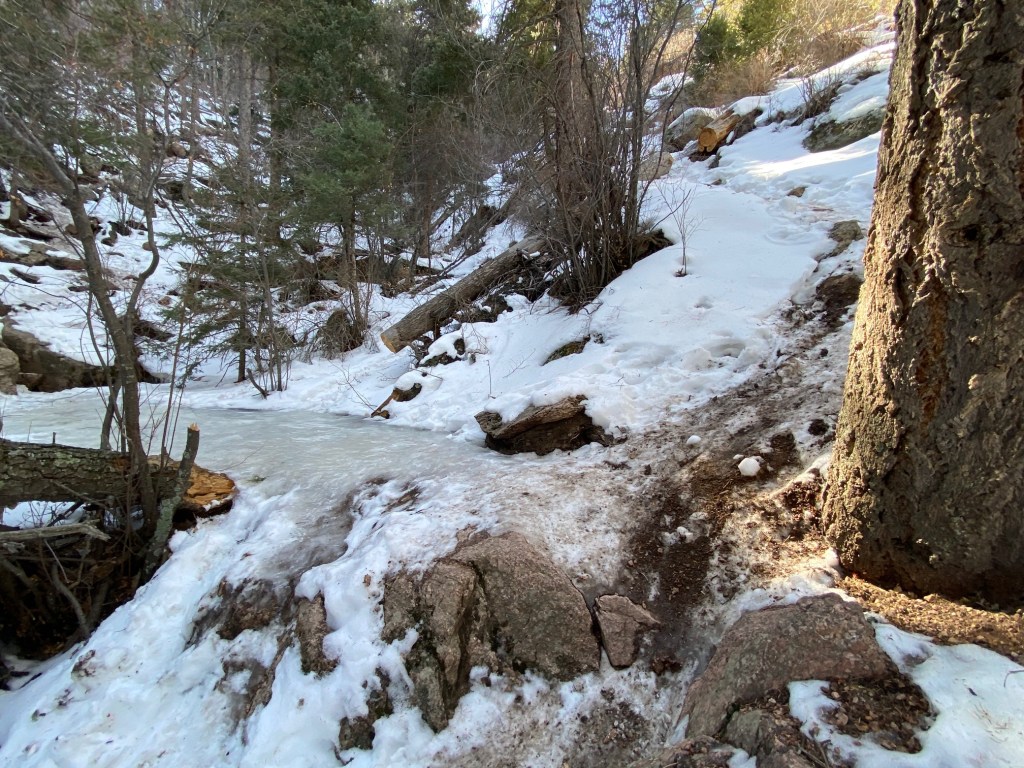
On a recent hike with seasoned professional Randy Phillips to Eagle Peak; 3 miles round trip, 2000 feet of vertical, a peak at 9366 feet elevation; we took the wrong turn because we thought the “well-traveled” trail was the right trail.  After about 30 minutes and climbing 300 feet, we realized we were on a trail, but not the one we needed.  We then kept look down at what we just climbed (not wanting to make that descent) and looking for a way to bushwhack across to the trail we needed.  And we didn’t like either option.  Finally, we decided to make the descent looking for the trail we missed.  We knew it was down there, as we kept repeating, “just another 50 feet to go down.”  And then, there it was; the trail we missed on the other side of this ice flow.  At which time, Randy Phillips said (so appropriately), “This is starting to feel like the makings of a Trail Trip.”  And in more than just one way.  1): we don’t call it mistake when we pick up a “wrong” trail, we call it getting extra credit for the additional distance and vertical we get from it. 2): when we realize we need to get back on the “right” trail, do we try for the short cut, thinking we can bushwhack across an unknown traverse, or do we take the extra time/distance to descend to pick up the trail where we left off?   3): Do we get comfortable and relax our trail awareness, because we think we think the path is so “obvious” and we don’t look for other trails that are beyond an obstacle?  And how do we apply these three lessons to our hiking, personal, and work life?

1): Getting extra credit.  How do we process mistakes we make?  Do we see them as time and energy wasters, getting upset about the mistake or do we look at it as an extra credit lesson we can apply the next time we are in a similar situation?  Rest assured, the next time we do Eagle Peak, I will not miss this trail turn to the left. In our personal life, do I stew and get moody about mistakes I’ve made or do I talk to family members about what happened, why it happened and what we all need to do differently.  And then at work, do I try to cover up my mistakes before anyone sees them or am I transparent about them with my co-workers and management.

2): Recovering from a mistake.  How do we fix our mistakes?  Do we get to the root problem or just try to cover it up?  In hiking, we tend to want to aim for the shortest distance to get back on a trail, often not knowing what obstacles lie ahead when we are bushwhacking. In our personal life, I tend to want to just cover things up.  Let’s just put a band-aid on it and hope it goes away.  Or do I take the painful time to clean out the problem and make it right.  This often happens to me with home repairs…  And then there are the work problems we need to correct.  We think no one sees the mistake and we can just spend some extra time fixing it before anyone notices it.  As mentioned above, we need to have complete transparency here to state the problem, tell how it happened, and describe the steps we are taking to correct it.

3): Getting comfortable.  It’s been said that most car accidents happen within a five-mile radius from our homes because we get comfortable and relax our awareness.  We don’t pay attention to the things that may have changed and we don’t ask the obvious questions.   In hiking do we notice the different trails that are connected to the trail we are on?  Do we stop to look beyond the obstacles that may be in front of us?  In our personal life, do I take for granted the relationships I have with my spouse, family members, and friends?  Or do I take the effort to maintain and improve them.  Then at work, do I treat things as obligations, doing the minimal effort needed or do I have a passion for excellence in everything I do?

In a word, I think it’s AWARENESS!  Staying focused and sharp in the situation of the moment.  Where do you tend to get comfortable in your hiking, personal, and work life?  How do you handle mistakes and recover from them?